Showing posts with label Polaroid Time Zero Film. Show all posts

Saturday, June 6, 2009

PURPLE CALALILY TRIO

Purple Calalily Trio

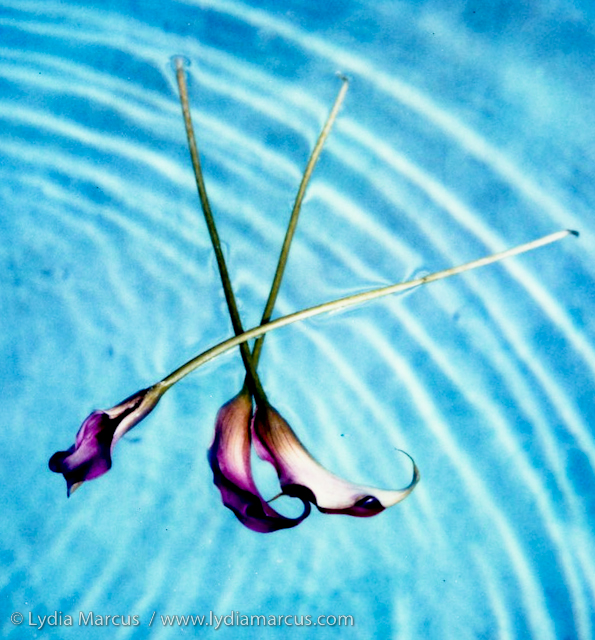
This is a perfect example of what makes Time Zero film so special and irreplaceable. It's why I have 13 boxes of it stockpiled in my fridge and literally wait for special things to photograph with it. There is nothing quite like TZ blue - it is just dreamy. Something about TZ makes images look like paintings. I love calalilies and these were a present. Since they only live a few days or so after they're cut, I thought this was the best way to immortalize them. The blue backdrop is courtesy of my swimming pool.

Photo by © Lydia Marcus
Polaroid SX-70 Alpha / Polaroid Time Zero Film
Photographed in Encino, CA

Wednesday, October 1, 2008

MAMA'S ROSES

My Mom has been gone for nearly 6 years but her roses remain blooming in the front yard. Polaroid Time Zero film seemed like the perfect way to capture their muted quality.

"Mama's Roses" Polaroid photo by Lydia Marcus.
Photographed September 31, 2008 in Encino, CA.

Saturday, August 2, 2008

STARS AND STRIPES IN TIME ZERO

I originally posted this shot as part of my 4th of July party wrap up, but I think that it got kind of lost among all the other snaps and I'd like to give it a solo spotlight. Also, if you like this image, please go vote for it at jpgmag.com where it's currently up for the "Geometry" theme. Voting is open until August 12, 2008.

"Stars & Stripes in Time Zero"
Polaroid photo by Lydia Marcus.

Photographed July 4th, 2008 in Encino, CA using a Polaroid SX-70 Alpha and expired Time Zero film.

Thursday, July 31, 2008

FAMILY VACATION CIRCA 1979

In August 1979 I went on a road trip with my Mom, Grandma Belle and her boyfriend Harry. We travelled all the way up North until we hit Canada. Our main stops along the way that I recall were San Francisco, Seattle, and Vancouver. Here's a Polaroid (One Step camera using Time Zero film) of three generations. The car was my Grandma's Chevy Monte Carlo (bright yellow with a black landau top). The Monte Carlo had just passed through the Chandelier Tree in Northern California. From Wikipedia: "Chandelier Tree is a 315 foot (96 metre) tall coast redwood tree in Leggett, California with a 6 foot (1.83m) wide by 9 foot (2.74m) high hole cut through its base to allow a car to drive through. The hole was carved in the 1930s."

To see more photos from this series, check out my flickr set FAMILY.

Wednesday, July 16, 2008

THE SWIMMER

My Dad swimming freestyle laps captured in Polaroid Time Zero.

I like that my shadow is in the shot.

For a comparison, here's a Fuji Instax 200 shot. The blues are much more vivid and saturated in Instax (actually much more so than in reality).

Dad doing the backstroke.
Polaroid 600 Film taken with a Polaroid SLR 680 SE

Instax makes the water swirls look like fire.

A portrait from Polaroid 195 with expired Polaroid ID-UV Film.


The story below is an article I wrote for the Los Angeles Times about my father, his lifetime connection to swimming, and how swimming saved him from the Holocaust. It was originally published in the Times' Calendar section in 2005. Many people who have known me as a writer have read it, but many of you who know me from my photography have not. I think it's a very relevant accompaniment to the photos seen above.

Swimming Out of Troubled Water
by Lydia Marcus
03-30-2005
Los Angeles Times

The lasting mark my father, a Holocaust survivor, has made on me is not from the tiny bits he has shared about his past, but from what he hasn't said. My dad has always told me that he had to draw an imaginary line between his past and his present to be able to emotionally survive and live his life. Since I understand his coping mechanism, I've never really delved into deep conversations about his personal history. One of the few aspects of his early years he would mention was the swim club Hakoah. Yet it wasn't until I saw the documentary "Watermarks," which opens here Friday, that I learned how it saved his life.


My dad, Fred Marcus, began swimming in Vienna as a little boy. As a teen, he participated at the Hakoah Vienna Sport Club, and eventually escaped the Nazis by emigrating to Uruguay, where he became a national swimming and diving champion for longer than a decade. He kept on swimming when he emigrated to the U.S. in the 1950s, and in the early 1970s taught me (at 3) to swim freestyle. Today, at age 83, he's still swimming.

I've never prodded my dad about his past, but after we saw "Watermarks" together last week at the L.A. premiere, we began to talk about it. He delved deep into his memory and reached into his private drawer of swimming mementos to show me saved Hakoah items I never knew existed -- a cloth bathing suit and a patch bearing the Hakoah name and a Jewish star, competition medals, and a Hakoah newsletter from the 1950s published to keep its members connected around the globe.

"Watermarks," directed, written and produced by Yaron Zilberman, unearths the previously untold story of the Hakoah Vienna Sport Club and its formation in 1909 in response to the Aryan Paragraph that forbade Austrian sports clubs from accepting Jewish athletes.

Zilberman, 38, an Israeli Jew who's lived on and off in the U.S. the last 12 years, stumbled upon the story while doing research for a film he was producing on the world's greatest soccer stars. He learned about the Hakoah's 1920s-era soccer team, which gained acclaim as the first team to defeat an English team on English soil. With no men alive from that team, Zilberman chose to concentrate on the living members of the women's swim team that was the "flagship of the club" during the 1930s.

Zilberman felt a personal connection to the female swimmers, who reminded him of his late grandmother, a Holocaust survivor and one of the people the film is dedicated to.

Almost all of the women featured in the film are swimmers whom my dad knew as a teenager. The film follows how swim team president Valentin Rosenfeld and women's swimming team head coach Zsigo Wertheimer arranged through illegal and legal means to get their female swimmers and most other Hakoah athletes (including my dad) out of Nazi-occupied areas.

Discovering the Hakoah ("The Strength" in Hebrew) was a "complete surprise" for Zilberman, who said in a phone interview that his own image of Jews prior to World War II had been either an "Orthodox, a bohemian, philosophers, artists, but definitely not sports people." For Jewish young people who were used to being discriminated against, the Hakoah served as a place where they could fit in.

Despite their many athletic successes, the Vienna Hakoah came to an end when Austria was annexed by Nazi Germany in 1938 during the Anschluss. My dad recalls going to the Hakoah's Dianabad swimming pool after the Nazis had taken it over and being confronted by a sign that read "No Jews allowed."

Soon after, his family fled to Brussels, where they essentially lived in hiding for a year. It was there that my dad received the most significant letter of his life.

He recalls: "Dr. Rosenfeld notified us there was a possibility to get out of Europe, to emigrate, and if I was interested I should go to the Uruguayan consulate." One week later, the 18-year-old began the monthlong journey there by boat -- with only the clothes on his back, one suitcase, 10 American dollars and his father's gold and lapis ring, given to him in case he needed to sell it for cash.

That was the last time that my dad would see his father, who was first interned by the Nazis in the Pyrenees and later died at Auschwitz just days before it was liberated. That 10 dollars soon went to the family of two Hakoah swimmers, who took him in in Montevideo, but he still wears his father's ring today.

Zilberman believes that Rosenfeld's story of saving the Hakoah members is "by itself a film" and has already been approached by a Hollywood producer who wants to make a movie about the Hakoah's escape operation.

Although the Hakoah Holocaust survivors do not bear the tattooed mark forced upon many concentration camp survivors, Zilberman says "at the same time they also have a mark." For someone like my dad, Zilberman feels that mark "is below the flesh, in a way. It's a watermark; you don't see it, but it's there."

I've always intuitively felt that mark within my dad, but now because of Zilberman's film, his long-buried history has been allowed to surface. Now when I see him swim, I know that each stroke has sustained his survival.

POST NOTE: July 16, 2008:

My Dad is now 86 years old (he turns 87 in September). He still swims, as these Polaroids and Fuji Instax shots attest. In the original story I wrote how my Dad kept on swimming despite different traumas in his life. I can also add that my Dad has kept on swimming after the death of my Mom in late 2002. My Dad doesn't talk much (to me or to anyone else), but consistently the only place we seem to ever have real conversations is either in the pool (usually while relaxing in the Jacuzzi) or while reclining across from each other on chaise lounges facing the pool. For both of us, water is magical, spiritual, and restorative.

An important fact that was edited out of the original story is that the reason my Dad was able to be issued an Uruguayan visa was that Uruguay was accepting minors and my Dad was under 18 years old at the time that the visa was approved and issued. My Dad actually turned 18 while in transit to Uruguay. The timing of the visa was impeccable - the difference of a week's time could have been life or death for my Dad. Pretty amazing.
Saturday, July 12, 2008

SWIMMIN' & BBQ'N ON THE 4TH

Last week I had a 4th of July party. Despite leaving four cameras outside (two Polaroid cameras - my SLR 680 SE and my 195), a Nikon D40, and my waterproof Sony U60, I was so busy being a hostess that I barely got any photos of the day. And the only photo of myself turned out blurry. As much as I love taking photos, the day was about sun, bbq, and socializing, so picture taking be damned. I spent what little free time I had in the pool, so the majority of shots came from the Sony. During the day we noshed on fresh fruit (watermelon, pineapple, peaches, nectarines, apricots), had a bbq dinner of shrimp skewers (a big hit!) made by Cathy Thaden, burgers and hot dogs (Kosher beef and turkey) cooked up by the grillmaster Serena), and for dessert I served ice cream sandwiches, bars, and drumsticks to help beat the heat plus I honored my Mom's memory by making her famous confetti jello for the very first time. I'm saving the photos and recipe for the confetti jello for a future post.

My appetizer and condiment layout


Ice Teas - The labels are askew because I put them on while the pitchers were attached to the brewer and couldn't really see what I was doing. I had a TON of soft drinks and waters too, but no photo.

Polaroid Time Zero shot - my single TZ shot of the day. I only have about 150 shots left of the stuff and that's it, so I gotta conserve! Blue and water always look great in TZ so I thought this was a good subject for it. These American flag inner tubes were only $2.99 at Leslie's pool supply!

John was the first to figure out that the best place to hang out was in the pool.

Dave and John

Paul, Serena, Gale, and John. They had a pretty good game of catch football going on for quite some time. John managed to lob me in the face when I thought I had made it clear that I was taking a time out to have a conversation with someone standing on the deck. Luckily, the football is basically like a big, squishy sponge so I was just fine.

The rest of these shots were taken with my ancient Sony Cybershot U DSC-U60 - a waterproof 2 megapixel digital camera with a fixed 33mm lens that has a fast 2.8 aperture.

Lucy The Boxador, Caroline, Baby Diana, and Paulus

Me and Serena - of course the only blurry shot I took all day was of myself! DOH!!!

Sonya

Danny and Rhea

Masha

Lawrence

Rhea

Baby Diana

Danny and Rhea's son Sebastian

Paulus, Dad, Lucy

Paulus, Dad, Lucy

Lucy being brave and coming up to the edge of the pool.

Lucy is pretty sensitive to new people and especially to men in general. I didn't know how she was going to handle having the backyard invaded with people. I expected a lot of barking and freaking out but she did really well. The only time she barked was when people came up the driveway, but once they were in the backyard she didn't make a peep. I could tell she was a little nervous, but she was a trouper and always wanted to be outside with me and the guests despite the major heat that had her panting for most of the day. I guess I was preparing for the worst and she pleasantly surprised me with dealing with a totally new situation and stimuli. And she didn't even beg for food or pester people who were eating. Lucy gets an A+ for her first 4th of July in the Marcus home!

Paul and Masha

Paul

Sebastian

Friday, June 20, 2008

CAR WASH

I don't remember why, but for some reason I decided during the 100+ degree mid-day heat that I was going to go out in the front yard and hose down three Tonka cars that have been neglected outside for a few years. I got the Tonka truck and two Jeeps from various garage sales when I was a little kid. They were in beat up condition when I got them. I always took care of my toys when I was a kid and anything that I bought new always looked new forever more and anything I got that was beat up stayed that way and didn't degrade a step further. But while the rest of my childhood toys have been safetly kept inside, somehow these three ended up being stored outside in the elements for the last few years. There was so much dirt and gunk accumulated on the cars that I had to spray them for awhile, which left puddles on the lawn where the cars were standing. When I was a kid, I never would have taken a hose to my cars, let alone let them stand in mud, but now, this seemed like the perfect photographic moment and a fitting environment for these off road vehicles models. I ran inside to grab my Polaroid SLR 680 SE, my Polaroid SX-70 Alpha, my Polaroid 195 (and the close up and portrait lens attachments), plus my Nikon D80 with the f1.8 lens to grab a few digital shots. I wish I had a close up attachment for my 680 - I never feel like I can get close enough. The photos were taken in an area shaded by a big tree, so the SX-70 Time Zero shots turned out mostly fuzzy. I guess they needed more light.

This was my best Polaroid shot, taken with the Polaroid 195 using Fuji FP-100C that was expired in January, 2007

The focus isn't perfect on this but I like the mood.

A total blur but I like the effect. The Fuji colors are so much bolder than the cheapie Polaroid ID-UV that I usually use. I save the Fuji for the good stuff.

I thought this one was my best of the 680 shots.


I love the size comparison between the cars and Lucy.

Lucy was pretty overheated outside. She noticed the water that had collected in the back of the truck so she walked over to it and started lapping it up!

I thought that the truck photographed the best out of the three cars - it looked the most authentic and least toy like. The way the paint is distressed looks just like on a real car.


I like this shot, it looks like the truck is about to drive through a creek.

It's hard to make out because the lettering is rubbed off a bit, but the Jeep is adorned with writing that says U.S.A.F.


Here's a Time Zero shot of Lucy resting in the shade after having enough of the heat.