Fred Marcus, 89 © Lydia Marcus 2010 / www.lydiamarcus.com
Photographed September 17, 2010 in Encino, CA
Showing posts with label Dad. Show all posts
Showing posts with label Dad. Show all posts
Friday, September 17, 2010
FRED MARCUS, 89


Friday, May 15, 2009
A FACE IS LIKE A WORK OF ART, IT DESERVES A GREAT FRAME
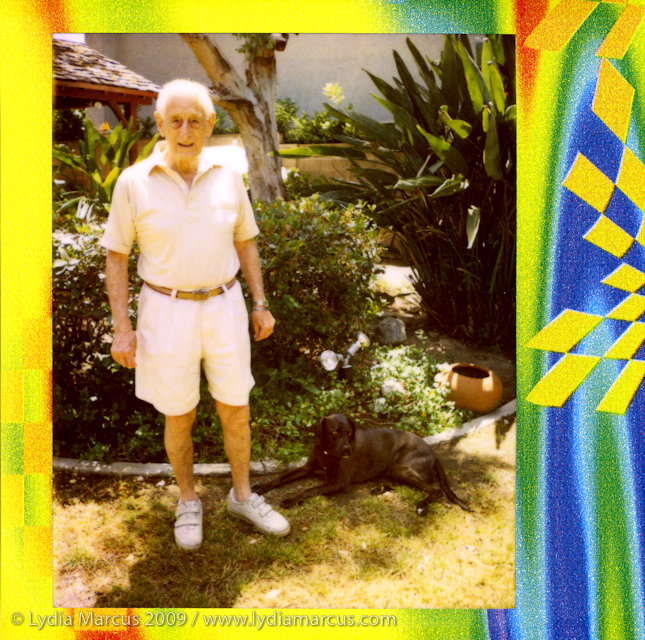
My Dad and Lucy The Boxador.
This is VERY special Polaroid film called Image Wild Sides. I got it from polapremium.com where it's $16 dollars a pack (plus shipping). I never knew they made Wild Sides for Spectra cameras. I used to love shooting the 600 version in my One Step. I held onto my last pack for years and just tried shooting it and it was a total dud - what a disappointment. Well at least I have 3 boxes of the Image Wild Sides to shoot. They're dated 10/2008 but the color is perfect. I gotta get my hands on more of this stuff!
Photo by © Lydia Marcus 2009
Photographed May 10, 2009 in Encino, CA
Polaroid ProCam with Image Wild Sides film (sold by polapremium)
Friday, February 27, 2009
IT WAS 39 YEARS AGO TODAY...

Click image to enlarge my birth announcement, scanned from my baby book. "Unbelievable?" my Mom wrote because my parents were married almost 15 years before they finally had me - their one and only child - my Mom was 38, my Dad 48! No IVF, no multiple births, just moi! I share a birthday with Elizabeth Taylor, Joanne Woodward, Chelsea Clinton, Ralph Nader, and writers Henry Wadsworth Longfellow and John Steinbeck. Happy Birthday fellow Pisceans!
Thursday, December 25, 2008
MY SOCAL HOLIDAYS

Growing up, my Jewish family always celebrated both Hanukah and Christmas. As much as I liked getting a present eight nights in a row for Hanukah, like most kids sold on Santa Claus, the holidays really were about my Christmas stocking and finding presents under the tree.

My Mom grew up in Chicago, so her holiday tradition had always been stuffing the stocking with oranges and walnuts (with a few toys thrown in for good measure). Considering oranges were about as common in L.A. as cars and we had several walnut trees on our property, I didn't learn the significance of this fruits 'n nuts combo 'til I was an adult. As a first generation Los Angeleno used to warm winters I didn't realize that during my Mom's Midwest upbringing, having oranges and walnuts in December was a special treat.
Since my Mom passed away six years ago, my ex has picked up the torch with her own twist on this holiday family tradition - a Christmas stocking filled to the brim with walnuts and Satsuma tangerines, a rare seasonal treat.

One of my favorite childhood holiday memories was getting to see my first Hollywood Christmas Parade when I was thirteen, but my view was quite different from all the spectators lining Hollywood Boulevard - I experienced the parade perched high atop the Childhelp USA float standing alongside Olympic ice skaters Tai Babilonia and Randy Gardner and child horror princess Heather O'Rourke. I went to junior high with the girl whose mom co-founded Childhelp USA and became part of their youth group Wings. Being parts of Wings was kind of like being a Girl Scout but without wearing the cool green uniforms. We did art projects, assisted with fundraisers, and had social gatherings. One day I showed up for a meeting and got the nice surprise of learning I had won a spot on their Hollywood Christmas parade float because I was the only Wings member with perfect attendance.
For my TV debut I was given the special uniform of a white sweatsuit embroidered with Childhelp's blue Dove logo across the heart. I'm sure I probably looked like a chubby snowball but I was proud to wear the outfit. Considering this was 1983, getting to be on a float with America's Sweethearts Tai and Randy and the star of "Poltergeist" who captured America's attention with that famous line, "They're here," was beyond cool. The float had moved barely a block, just past the T.V. cameras, when it came to a grinding halt. I don't remember what the problem was (a busted tire?) but we were all whisked away to a private V.I.P. tent for the remainder of the parade. While I thought getting to be in the parade would be a highlight of my life, honestly it was extremely cold on Hollywood Blvd (yes even in my glamorous sweatsuit) and the V.I.P. tent turned out to be warm, stocked with a gourmet buffet, and filled with every major television star of the era. The float breaking down was the best thing that could have ever happened to me! I spent my night going from table to table meeting all my T.V. idols, getting autographs from stars like Denver Pyle (Uncle Jesse on "Dukes of Hazzard"), Ted Lange ("The Love Boat"), cuties Greg Evigan ("BJ and the Bear"), Ted McGinley ("Happy Days") and Jeff Conaway ("Taxi" and “Grease”), and then Vic Tayback ("Alice") even wrote, "Lydia, Stow It!! Love, Vic Tayback 'Mel'." I've never been back to the Hollywood Christmas Parade since that star-filled night, really, how could any subsequent parade ever live up.
Sure L.A. doesn't have distinct seasons like the Midwest and East Coast (I mean it’s December and the leaves are just turning), but there's plenty of ways to get into the holiday spirit even while living in lalaland. My favorites are making the drives through the Valley’s own “Candy Cane Lane” and visiting the DWP Holiday Light Festival (kind of like LITE BRITE on steroids). Add a little hot chocolate and it's always a perfect night.
Where To Go For A SoCal Holiday Experience:
DWP Holiday Light Festival: This free light display was designed to "symbolize" the Los Angeles Department of Water and Power's "proud history and shared legacy of service to the people of the city."

The display, now in its 13th year, is probably the only time of year L.A. denizens will feel all warm and fuzzy when thinking about the DWP. Not only does the festival highlight DWP achievements (like the "Cascades" and William Mulholland, the man who brought water to the desert of L.A.)

but really it's the one place in the vast city of Los Angeles that salutes our major landmarks like City Hall, the Hollywood Sign and the film business of "Hollywood", LAX and the space age Encounter building,

Griffith Observatory,

and Hollywood Bowl.

The Holiday Light Festival runs along a one-mile segment of Crystal Springs Drive (in Griffith Park near the L.A. Zoo) with two lanes for cars, a single lane for free shuttle buses (parking is at the L.A. Zoo), and a sidewalk for people willing to brave the cold to see it on foot. Enhancing your experience as you pass by the display, holiday tunes supplied by KOST FM whisper through the air. This year the DWP added a pedestrian only “vehicle free” week to demonstrate their continuing commitment to a “greener” L.A. I went on one of these nights and seeing so many people on foot checking out the light displays truly felt like more of an East Coast experience – the only thing missing was some faux (or real) snow. This nightly light show stars at twilight (5pm) and ends at 10pm. The festival runs through December 30, 2008.
Candy Cane Lane:
Since the early 1950's, neighbors in an ordinarily sedate section of Woodland Hills (in the "Valley") have been trying to one up each other with over the top holiday lighting displays. The main drag of "Candy Cane Lane" is Lubao, but a few surrounding streets also evoke holiday themes that feature candlelight, jingle bells, and Santa Claus.

Despite being a residential neighborhood, local entrepreneurs have been known to sell mistletoe, hot chocolate, and even funnel cakes (yum). Residents request that visitors drive by no later than 10pm on weeknights, 11pm on weekends.
Directions: 101 N/S exit Winnetka, head North, immediate right Martha, left Lubao “AKA” Candy Cane Lane.
- Lydia Marcus
(1st photo - Hanukah 1972 - pictured L-R: Grandma Belle, Mom, Me @ 2, Dad, Uncle Fritz, Aunt Lisa)
(2nd photo - Christmas 1974 - Santa Claus & Lydia, age 4)
Saturday, September 6, 2008

Thursday, August 7, 2008
THE SWIMMER PART 2
More portraits of my Dad at the pool, this time shot digitally. He turns 87 in less than a month.


When i was a kid, my Dad could lay on the floor of the pool for at least a minute (probably more). He would just let out a little bit of air at a time - teeny, tiny bubbles. My Dad isn't that playful of a person, but this always was a crowd pleaser! i'm naturally too buoyant to do this.

Fred Marcus photos by Lydia Marcus
Photographed August 6, 2008 in Encino, CA


When i was a kid, my Dad could lay on the floor of the pool for at least a minute (probably more). He would just let out a little bit of air at a time - teeny, tiny bubbles. My Dad isn't that playful of a person, but this always was a crowd pleaser! i'm naturally too buoyant to do this.

Fred Marcus photos by Lydia Marcus
Photographed August 6, 2008 in Encino, CA
Wednesday, July 30, 2008
HAPPY ANNIVERSARY
Last night I was trying to find a photo of my Mom cooking or "entertaining" to use in a future blog post. I have tons of digital photos going back to 2001 but my Mom passed away in 2002 so I don't have that many digital images of her. The majority of photos of her are un-scanned 126 and 35mm photos we took while I was growing up. And those are crammed in boxes in no particular order. There are a couple of my Mom's albums from the era that predates me that are tucked away in a cupboard in the living room. I haven't looked through those photos in YEARS. Maybe decades. But at least I remembered where they were stored. So late last night I dug into the cupboard and pulled out two albums. I was surprised to find on the first page of the second album the original invitations to my parent's wedding. I don't recall every seeing it before. When my Mom first passed away in December of 2002, my Dad and I still celebrated their wedding anniversary when it came round. I'd give him a card, we'd choose a special restaurant that we used to all go together as a family, and basically we'd think about my Mom. Then either last year or the year before, we didn't observe the day. I forgot, he didn't mention it, and time went on. I never was that great at remembering the actual anniversary date - I seem to recall it being either the end of June or end of July. But last night when I opened that album I looked at the wedding date and it was staring back at me - July 30, 1955 - literally a few hours away. Today I brought out the album to show my Dad the invitations and for some reason he thought the 30th was still to come, not today's date. When I told him it was today, he was surprised (and of course it's a bit emotional). I left him the album to peruse while I began scanning a few images I had pulled out for this blog. Deciding to get the album and go through it the night before their anniversary (without actually realizing the date) and stumbling onto the wedding invitation and photos from their honeymoon strikes me as another incident that goes beyond "coincidence." I've written about my Mom's touch before and this seems like another one of those times. Here are some photos of my parents from their early days and a few from the last year of my Mom's life. Happy Anniversary Mom and Dad, today would have been your 53rd.
Dr. and Mrs. William Burton request the honor of your presence at the marriage of their daughter Beverly to Fred Marcus on Saturday, the thirtieth of July, Nineteen Hundred and fifty-five at seven o'clock in the evening.

Their wedding photo. My Mom was absolutely gorgeous.

The Point "Just Married"

Honeymoon, August 1955. My Mom's inscription jokes, Oakton "Manure" Manor. I think my Mom looks like a glamourous movie star here in her bathing suit. Esther Williams watch out!

My Dad the swimmer in his white speedos.

This is a screen grab from a home movie I had converted from 8mm to video. To my surprise, most of the home movies were in glorious color.

Another from the home movies

My Mom is wearing the same outfit here, so the photo is probably taken the same day as the home movie.

My Mom's caption reads: "could choke him, but I adore him." I think that pretty much sums up their entire marriage.

My Dad and Mom on her 70th birthday in 2001.

May 2002

The last mother's Day, 5.12.02, The Bistro Garden in Studio City. Believe it or not, the guy wearing sunglasses in the background between my Parents is David Cassidy! I guess he was out with his Mom too.

Dr. and Mrs. William Burton request the honor of your presence at the marriage of their daughter Beverly to Fred Marcus on Saturday, the thirtieth of July, Nineteen Hundred and fifty-five at seven o'clock in the evening.

Their wedding photo. My Mom was absolutely gorgeous.

The Point "Just Married"

Honeymoon, August 1955. My Mom's inscription jokes, Oakton "Manure" Manor. I think my Mom looks like a glamourous movie star here in her bathing suit. Esther Williams watch out!

My Dad the swimmer in his white speedos.

This is a screen grab from a home movie I had converted from 8mm to video. To my surprise, most of the home movies were in glorious color.

Another from the home movies

My Mom is wearing the same outfit here, so the photo is probably taken the same day as the home movie.

My Mom's caption reads: "could choke him, but I adore him." I think that pretty much sums up their entire marriage.

My Dad and Mom on her 70th birthday in 2001.

May 2002

The last mother's Day, 5.12.02, The Bistro Garden in Studio City. Believe it or not, the guy wearing sunglasses in the background between my Parents is David Cassidy! I guess he was out with his Mom too.

Wednesday, July 23, 2008
THE ENGINEER
I was in the backyard taking a Polaroid of the pool tile when the portrait lens viewfinder attachment for my 195 fell off and sunk to the bottom of the deep end of the pool. My Dad fished it out with the skimmer and after I dried it off, I tried to take a photo of him but couldn't focus at all with the rangefinder. The little glass window on the attachment was totally fogged over with condensation. The 195 can be hard enough to focus in bright light, but here I was in the dim light of twilight with a film of fog over the rangefinder. I took a closer look at the attachment and figured out that there were teeny, tiny screws that held it together and that it could be opened up and really cleaned. My Dad, the lifetime engineer and Mr. Fix It took it upon himself to do the repair and cleaning for me. Now that he's had both his cataracts removed in the last year, I think he can actually see better than me! Once he got the attachment open he told me, "You clean glass with alcohol. I learned that when I worked at a lab at Northrop." I don't really know anything about my Dad's time at Northrop, so I asked him what kind of lab he worked in and he told me that he inspected parts for guided missiles. From as long as I can remember - from early childhood until college graduation - the only company my Dad worked for was Hughes Helicopters (as in Howard Hughes). He was a Quality Control engineer and under his watch there were never any helicopter accidents due to parts failure. Unlike most companies that want to get rid of their older workers, Hughes (then taken over by Boeing) begged my Dad to stay on with the job when he retired at the age of 70. Having worked full-time since he was 18 and with me finally out of college, my Dad had enough of working and retired despite the bonuses dangled before him. Anyway, back to the present - after a few swabs with alcohol and dealing with the tiniest screws known to man - my Dad got the viewfinder attachment clean and clear again, in fact I think it was actually cleaner than when I started. So dropping it in the pool turned out to be a happy accident indeed!
My Dad begins the repair as Lucy The Boxador looks on.


Polaroid 195 shot

The Engineer photos by Lydia Marcus
Photographed July 5, 2008 in Encino, CA
My Dad begins the repair as Lucy The Boxador looks on.


Polaroid 195 shot

The Engineer photos by Lydia Marcus
Photographed July 5, 2008 in Encino, CA
Wednesday, July 16, 2008
THE SWIMMER
My Dad swimming freestyle laps captured in Polaroid Time Zero.
I like that my shadow is in the shot.

For a comparison, here's a Fuji Instax 200 shot. The blues are much more vivid and saturated in Instax (actually much more so than in reality).

Dad doing the backstroke.
Polaroid 600 Film taken with a Polaroid SLR 680 SE

Instax makes the water swirls look like fire.

A portrait from Polaroid 195 with expired Polaroid ID-UV Film.

The story below is an article I wrote for the Los Angeles Times about my father, his lifetime connection to swimming, and how swimming saved him from the Holocaust. It was originally published in the Times' Calendar section in 2005. Many people who have known me as a writer have read it, but many of you who know me from my photography have not. I think it's a very relevant accompaniment to the photos seen above.
Swimming Out of Troubled Water
by Lydia Marcus
03-30-2005
Los Angeles Times
The lasting mark my father, a Holocaust survivor, has made on me is not from the tiny bits he has shared about his past, but from what he hasn't said. My dad has always told me that he had to draw an imaginary line between his past and his present to be able to emotionally survive and live his life. Since I understand his coping mechanism, I've never really delved into deep conversations about his personal history. One of the few aspects of his early years he would mention was the swim club Hakoah. Yet it wasn't until I saw the documentary "Watermarks," which opens here Friday, that I learned how it saved his life.
My dad, Fred Marcus, began swimming in Vienna as a little boy. As a teen, he participated at the Hakoah Vienna Sport Club, and eventually escaped the Nazis by emigrating to Uruguay, where he became a national swimming and diving champion for longer than a decade. He kept on swimming when he emigrated to the U.S. in the 1950s, and in the early 1970s taught me (at 3) to swim freestyle. Today, at age 83, he's still swimming.
I've never prodded my dad about his past, but after we saw "Watermarks" together last week at the L.A. premiere, we began to talk about it. He delved deep into his memory and reached into his private drawer of swimming mementos to show me saved Hakoah items I never knew existed -- a cloth bathing suit and a patch bearing the Hakoah name and a Jewish star, competition medals, and a Hakoah newsletter from the 1950s published to keep its members connected around the globe.
"Watermarks," directed, written and produced by Yaron Zilberman, unearths the previously untold story of the Hakoah Vienna Sport Club and its formation in 1909 in response to the Aryan Paragraph that forbade Austrian sports clubs from accepting Jewish athletes.
Zilberman, 38, an Israeli Jew who's lived on and off in the U.S. the last 12 years, stumbled upon the story while doing research for a film he was producing on the world's greatest soccer stars. He learned about the Hakoah's 1920s-era soccer team, which gained acclaim as the first team to defeat an English team on English soil. With no men alive from that team, Zilberman chose to concentrate on the living members of the women's swim team that was the "flagship of the club" during the 1930s.
Zilberman felt a personal connection to the female swimmers, who reminded him of his late grandmother, a Holocaust survivor and one of the people the film is dedicated to.
Almost all of the women featured in the film are swimmers whom my dad knew as a teenager. The film follows how swim team president Valentin Rosenfeld and women's swimming team head coach Zsigo Wertheimer arranged through illegal and legal means to get their female swimmers and most other Hakoah athletes (including my dad) out of Nazi-occupied areas.
Discovering the Hakoah ("The Strength" in Hebrew) was a "complete surprise" for Zilberman, who said in a phone interview that his own image of Jews prior to World War II had been either an "Orthodox, a bohemian, philosophers, artists, but definitely not sports people." For Jewish young people who were used to being discriminated against, the Hakoah served as a place where they could fit in.
Despite their many athletic successes, the Vienna Hakoah came to an end when Austria was annexed by Nazi Germany in 1938 during the Anschluss. My dad recalls going to the Hakoah's Dianabad swimming pool after the Nazis had taken it over and being confronted by a sign that read "No Jews allowed."
Soon after, his family fled to Brussels, where they essentially lived in hiding for a year. It was there that my dad received the most significant letter of his life.
He recalls: "Dr. Rosenfeld notified us there was a possibility to get out of Europe, to emigrate, and if I was interested I should go to the Uruguayan consulate." One week later, the 18-year-old began the monthlong journey there by boat -- with only the clothes on his back, one suitcase, 10 American dollars and his father's gold and lapis ring, given to him in case he needed to sell it for cash.
That was the last time that my dad would see his father, who was first interned by the Nazis in the Pyrenees and later died at Auschwitz just days before it was liberated. That 10 dollars soon went to the family of two Hakoah swimmers, who took him in in Montevideo, but he still wears his father's ring today.
Zilberman believes that Rosenfeld's story of saving the Hakoah members is "by itself a film" and has already been approached by a Hollywood producer who wants to make a movie about the Hakoah's escape operation.
Although the Hakoah Holocaust survivors do not bear the tattooed mark forced upon many concentration camp survivors, Zilberman says "at the same time they also have a mark." For someone like my dad, Zilberman feels that mark "is below the flesh, in a way. It's a watermark; you don't see it, but it's there."
I've always intuitively felt that mark within my dad, but now because of Zilberman's film, his long-buried history has been allowed to surface. Now when I see him swim, I know that each stroke has sustained his survival.
POST NOTE: July 16, 2008:
My Dad is now 86 years old (he turns 87 in September). He still swims, as these Polaroids and Fuji Instax shots attest. In the original story I wrote how my Dad kept on swimming despite different traumas in his life. I can also add that my Dad has kept on swimming after the death of my Mom in late 2002. My Dad doesn't talk much (to me or to anyone else), but consistently the only place we seem to ever have real conversations is either in the pool (usually while relaxing in the Jacuzzi) or while reclining across from each other on chaise lounges facing the pool. For both of us, water is magical, spiritual, and restorative.
An important fact that was edited out of the original story is that the reason my Dad was able to be issued an Uruguayan visa was that Uruguay was accepting minors and my Dad was under 18 years old at the time that the visa was approved and issued. My Dad actually turned 18 while in transit to Uruguay. The timing of the visa was impeccable - the difference of a week's time could have been life or death for my Dad. Pretty amazing.
I like that my shadow is in the shot.

For a comparison, here's a Fuji Instax 200 shot. The blues are much more vivid and saturated in Instax (actually much more so than in reality).

Dad doing the backstroke.
Polaroid 600 Film taken with a Polaroid SLR 680 SE

Instax makes the water swirls look like fire.

A portrait from Polaroid 195 with expired Polaroid ID-UV Film.

The story below is an article I wrote for the Los Angeles Times about my father, his lifetime connection to swimming, and how swimming saved him from the Holocaust. It was originally published in the Times' Calendar section in 2005. Many people who have known me as a writer have read it, but many of you who know me from my photography have not. I think it's a very relevant accompaniment to the photos seen above.
Swimming Out of Troubled Water
by Lydia Marcus
03-30-2005
Los Angeles Times
The lasting mark my father, a Holocaust survivor, has made on me is not from the tiny bits he has shared about his past, but from what he hasn't said. My dad has always told me that he had to draw an imaginary line between his past and his present to be able to emotionally survive and live his life. Since I understand his coping mechanism, I've never really delved into deep conversations about his personal history. One of the few aspects of his early years he would mention was the swim club Hakoah. Yet it wasn't until I saw the documentary "Watermarks," which opens here Friday, that I learned how it saved his life.
My dad, Fred Marcus, began swimming in Vienna as a little boy. As a teen, he participated at the Hakoah Vienna Sport Club, and eventually escaped the Nazis by emigrating to Uruguay, where he became a national swimming and diving champion for longer than a decade. He kept on swimming when he emigrated to the U.S. in the 1950s, and in the early 1970s taught me (at 3) to swim freestyle. Today, at age 83, he's still swimming.
I've never prodded my dad about his past, but after we saw "Watermarks" together last week at the L.A. premiere, we began to talk about it. He delved deep into his memory and reached into his private drawer of swimming mementos to show me saved Hakoah items I never knew existed -- a cloth bathing suit and a patch bearing the Hakoah name and a Jewish star, competition medals, and a Hakoah newsletter from the 1950s published to keep its members connected around the globe.
"Watermarks," directed, written and produced by Yaron Zilberman, unearths the previously untold story of the Hakoah Vienna Sport Club and its formation in 1909 in response to the Aryan Paragraph that forbade Austrian sports clubs from accepting Jewish athletes.
Zilberman, 38, an Israeli Jew who's lived on and off in the U.S. the last 12 years, stumbled upon the story while doing research for a film he was producing on the world's greatest soccer stars. He learned about the Hakoah's 1920s-era soccer team, which gained acclaim as the first team to defeat an English team on English soil. With no men alive from that team, Zilberman chose to concentrate on the living members of the women's swim team that was the "flagship of the club" during the 1930s.
Zilberman felt a personal connection to the female swimmers, who reminded him of his late grandmother, a Holocaust survivor and one of the people the film is dedicated to.
Almost all of the women featured in the film are swimmers whom my dad knew as a teenager. The film follows how swim team president Valentin Rosenfeld and women's swimming team head coach Zsigo Wertheimer arranged through illegal and legal means to get their female swimmers and most other Hakoah athletes (including my dad) out of Nazi-occupied areas.
Discovering the Hakoah ("The Strength" in Hebrew) was a "complete surprise" for Zilberman, who said in a phone interview that his own image of Jews prior to World War II had been either an "Orthodox, a bohemian, philosophers, artists, but definitely not sports people." For Jewish young people who were used to being discriminated against, the Hakoah served as a place where they could fit in.
Despite their many athletic successes, the Vienna Hakoah came to an end when Austria was annexed by Nazi Germany in 1938 during the Anschluss. My dad recalls going to the Hakoah's Dianabad swimming pool after the Nazis had taken it over and being confronted by a sign that read "No Jews allowed."
Soon after, his family fled to Brussels, where they essentially lived in hiding for a year. It was there that my dad received the most significant letter of his life.
He recalls: "Dr. Rosenfeld notified us there was a possibility to get out of Europe, to emigrate, and if I was interested I should go to the Uruguayan consulate." One week later, the 18-year-old began the monthlong journey there by boat -- with only the clothes on his back, one suitcase, 10 American dollars and his father's gold and lapis ring, given to him in case he needed to sell it for cash.
That was the last time that my dad would see his father, who was first interned by the Nazis in the Pyrenees and later died at Auschwitz just days before it was liberated. That 10 dollars soon went to the family of two Hakoah swimmers, who took him in in Montevideo, but he still wears his father's ring today.
Zilberman believes that Rosenfeld's story of saving the Hakoah members is "by itself a film" and has already been approached by a Hollywood producer who wants to make a movie about the Hakoah's escape operation.
Although the Hakoah Holocaust survivors do not bear the tattooed mark forced upon many concentration camp survivors, Zilberman says "at the same time they also have a mark." For someone like my dad, Zilberman feels that mark "is below the flesh, in a way. It's a watermark; you don't see it, but it's there."
I've always intuitively felt that mark within my dad, but now because of Zilberman's film, his long-buried history has been allowed to surface. Now when I see him swim, I know that each stroke has sustained his survival.
POST NOTE: July 16, 2008:
My Dad is now 86 years old (he turns 87 in September). He still swims, as these Polaroids and Fuji Instax shots attest. In the original story I wrote how my Dad kept on swimming despite different traumas in his life. I can also add that my Dad has kept on swimming after the death of my Mom in late 2002. My Dad doesn't talk much (to me or to anyone else), but consistently the only place we seem to ever have real conversations is either in the pool (usually while relaxing in the Jacuzzi) or while reclining across from each other on chaise lounges facing the pool. For both of us, water is magical, spiritual, and restorative.
An important fact that was edited out of the original story is that the reason my Dad was able to be issued an Uruguayan visa was that Uruguay was accepting minors and my Dad was under 18 years old at the time that the visa was approved and issued. My Dad actually turned 18 while in transit to Uruguay. The timing of the visa was impeccable - the difference of a week's time could have been life or death for my Dad. Pretty amazing.
Sunday, June 15, 2008
HAPPY FATHERS DAY 2008
Happy Fathers Day Dad!

Me and my Dad on our bikes in the front yard, sometime in 1977. I'm 7 years old, he's around 54 or 55. Taken with the family's Polaroid Super Shooter Plus. My Mom was probably the photographer. My Mom bought the bike at a garage sale, it was a purple Schwinn with monkey bars and a banana seat that was covered in a floral pattern.
A portrait of my Dad taken June 14, 2008 in Encino, CA at Libbit Park


Me and my Dad on our bikes in the front yard, sometime in 1977. I'm 7 years old, he's around 54 or 55. Taken with the family's Polaroid Super Shooter Plus. My Mom was probably the photographer. My Mom bought the bike at a garage sale, it was a purple Schwinn with monkey bars and a banana seat that was covered in a floral pattern.
A portrait of my Dad taken June 14, 2008 in Encino, CA at Libbit Park

Saturday, June 7, 2008
HAPPY PRIDE!
This weekend is the 38th annual L.A. Pride. I was actually at the first one in 1970! I was just a baby, my parents and Uncle went somewhere to eat on Hollywood Blvd and L.A.'s first ever gay parade (dubbed Christopher Street West) was in full swing. The first pride I have memories of is 1986. My best friend Robert Pavlick (R.I.P.) drove us down to West Hollywood in his Peugeot (I think a 505). On Sunset, he was driving pretty wild as usual and going way too fast on the way to a red light when the car next to us crossed into our lane and cut us off and Robert slammed on the brakes and threw us into a complete 360 spin! We survived the drive and walked up and down Santa Monica Blvd watching the parade. Afterwards we went to the festival, then an open, free event. I remember they even had carnival rides (like the Scrambler). While everyone was dressed casual summer, I recall being way overdressed in my new wave finery - a nice dress shirt (brown and black - some sort of animal print) buttoned up to the chin, black culottes, and my funky mod styled black and white clubbing shoes.
A couple of days ago I received a copy of the book "When I Knew" by Robert Trachtenberg - a compilation of coming out (to others and to oneself) anecdotes. HBO sent me a copy and a screener of the documentary directed by Fenton Bailey and Randy Barbato (from World of Wonder) based on the Trachtenberg's book. They're screening it in honor of Pride Month (actually I think their affiliate Cinemax is the one screening it). I haven't watched the film yet, but I did read the entire book on Thursday. I love the concept and it shows that most people's memories of their queerness goes back to early childhood with plenty of stories recalling ages 5-8. Many of the stories are funny, a few are sad, and some are downright poignant like this one:
1971, Abilene, Texas by Stephen Orr:
"My father was tossing a football with my brothers in the front yard. Seeing me sitting alone on the steps, my mother took my dad aside, "Dub," she said, calling my dad by his nickname, "I think Steve is feeling a little left out. Why don't you ask him if he'd like to play too?" So my dad walked over. "Wanna throw the football some?" he asked. "I'd really rather go pick flowes," I replied. And we did. My father, a former football coach, spent the rest of the afternoon picking flowers with me in a nearby field.
My only issue with the book is that within 120 pages, only about 10 stories are from women. Hopefully the documentary is a bit more balanced.
In honor of L.A. PRIDE weekend, here are some of my shots from a few of the last Pride events.


Everybody's favorite "Momma"

The grand dame - "Madame"


My Aunt Lisa always took me to this library when I was a kid.

West Hollywood "The Creative City"


Now that's one gay Pinto ;-)


A couple of days ago I received a copy of the book "When I Knew" by Robert Trachtenberg - a compilation of coming out (to others and to oneself) anecdotes. HBO sent me a copy and a screener of the documentary directed by Fenton Bailey and Randy Barbato (from World of Wonder) based on the Trachtenberg's book. They're screening it in honor of Pride Month (actually I think their affiliate Cinemax is the one screening it). I haven't watched the film yet, but I did read the entire book on Thursday. I love the concept and it shows that most people's memories of their queerness goes back to early childhood with plenty of stories recalling ages 5-8. Many of the stories are funny, a few are sad, and some are downright poignant like this one:
1971, Abilene, Texas by Stephen Orr:
"My father was tossing a football with my brothers in the front yard. Seeing me sitting alone on the steps, my mother took my dad aside, "Dub," she said, calling my dad by his nickname, "I think Steve is feeling a little left out. Why don't you ask him if he'd like to play too?" So my dad walked over. "Wanna throw the football some?" he asked. "I'd really rather go pick flowes," I replied. And we did. My father, a former football coach, spent the rest of the afternoon picking flowers with me in a nearby field.
My only issue with the book is that within 120 pages, only about 10 stories are from women. Hopefully the documentary is a bit more balanced.
In honor of L.A. PRIDE weekend, here are some of my shots from a few of the last Pride events.


Everybody's favorite "Momma"

The grand dame - "Madame"


My Aunt Lisa always took me to this library when I was a kid.

West Hollywood "The Creative City"


Now that's one gay Pinto ;-)


Subscribe to:
Posts (Atom)


 Posts
Posts